

Many product teams are shipping AI slowly. Why? Because new innovation brings a cost of change. Always. And while the type of innovation changes, there’s a way to think about when to move forward.
Here’s a scenario, based on a series of conversations with one of our customers (I'll call him Joe). Joe’s trying to solve a problem: his customers can’t tell whether his platform is delivering value with the current reporting. He’s evaluated several ideas and is proposing to deploy AI-based data agents alongside dashboards. That would mean customers could ask questions and better understand the platform value.
The Common Head-Tail Distribution of Analytics
Like many SaaS companies, this business rises and falls on adoption. Joe and his team have seen a clear pattern: customers who engage with data achieve better platform adoption and churn less. But the inflexibility of the current reporting makes getting data hard, so Joe and his team are constantly creating custom reports for them.
Custom reports are making the problem worse, not better. By one estimate, this mid-sized company is creating about 40 custom reports a month at 5 to 10 hours per report. Those hours are not only costly but are crowding out more strategic discussions with customers.
Joe sees the opportunity: Let customers ask free-form questions. Reduce the number of expensive, one-off reports. Help customers connect product usage to real business outcomes.
But Joe’s getting pushback internally: ”We already have reporting.” Those objections refer to the legacy analytics that are slow to change, hard to maintain, and not adequately showing platform value.
A strategic decision-making guide: the 10x rule
This is a classic technology problem. Adopt something now? Or stick with what’s there?
Product teams that operate strategically often reference the 10x rule: don’t introduce constant change for incremental benefits. But when you can achieve at least 10x vs the status quo, go for it.
And, conversely, when there’s technology that allows for a 10x improvement and you don’t adopt, you’ll be at a disadvantage relative to your competitors. It’s why you don’t see many software companies that don’t use the cloud.
The common objections with any tech shift:
“We already have X.”
Here’s where you test whether the value case offers 10x results.
With Joe, the X they already have is reporting. True. But it doesn’t answer the long-tail questions customers actually ask. This company’s reporting approach was state-of-the-art before AI opened new possibilities. But it had known limitations: static dashboards force users into predefined views. Their performance usually makes interactivity impractical. They’re hard to build, hard to maintain and rarely change.
Even with all of those problems, simply moving to a better dashboard platform isn’t better “enough” for teams to incur the cost of changing.
Here’s where AI comes in.
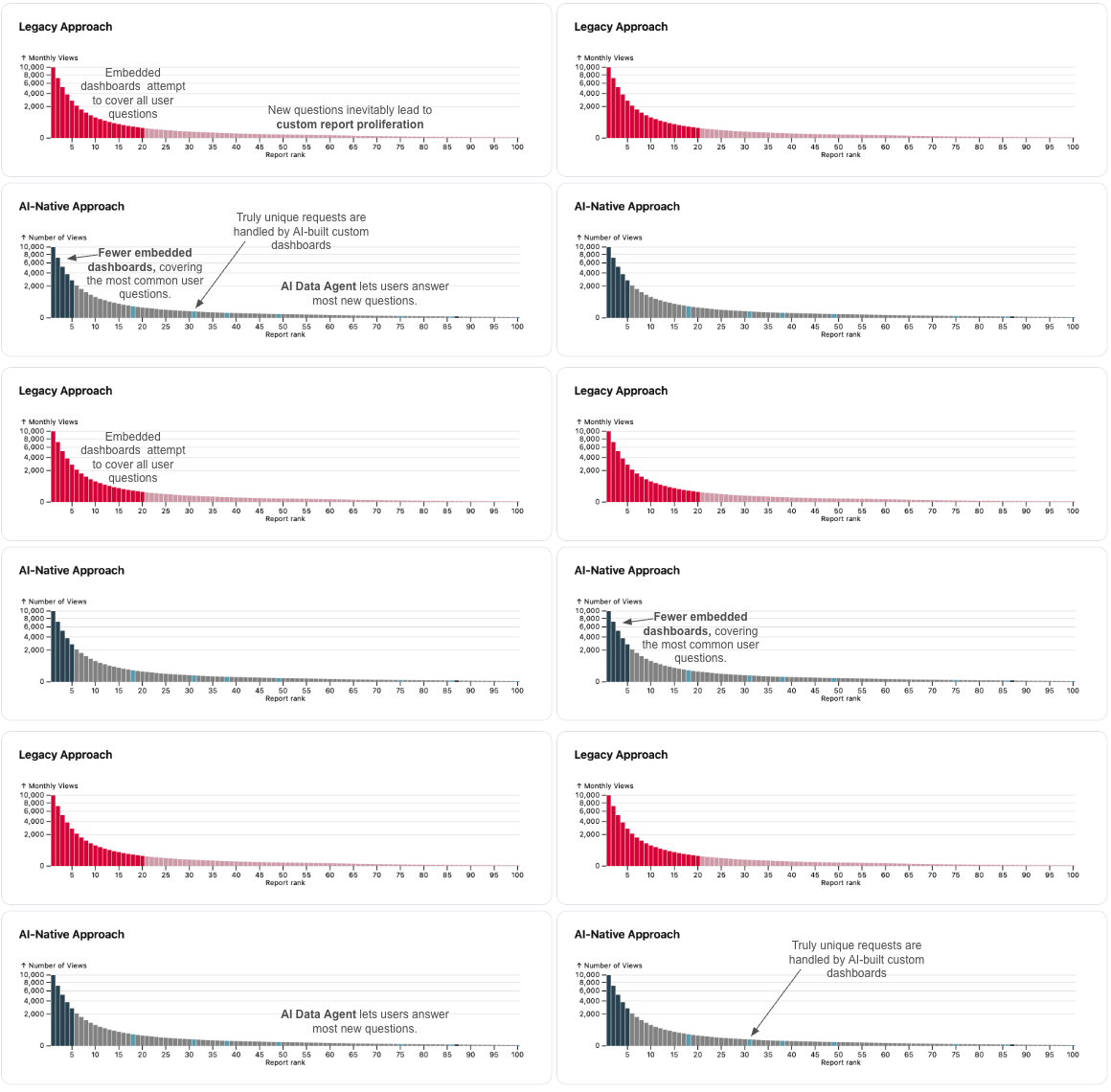
This diagram shows the natural head-tail analytics pattern: there are any number of questions you can ask about data. Most customers have similar questions (the “head” of the distribution), and there are many follow-ups to those questions (the “tail” of the distribution). Dashboards are perfect for the head of the distribution-- they are shared artifacts that provide sense-making about the data. Interactivity in a dashboard, when done well, can handle some of the tail, but many companies get trapped into dashboard proliferation-- both embedded in their platform and made bespoke for customers.
The tail is better handled with AI. A data agent can answer most tail questions, reducing or eliminating the need to endlessly build dashboards. When customers can ask questions naturally, they can find the value in the platform and relate it to their business outcomes.
10x technology often solves several problems at once. In AI-native analytics, the combination of less toil for the product team and more value for customers changes the value equation dramatically.
“We’ll introduce inconsistency.”
Legacy solutions built bespoke governance and business logic, creating lock-in and splitting the “source of truth.” The rise of semantic layers and catalogues has helped companies centralize that governance. Newer solutions are more pluggable and can respect those sources of truth, meaning that as you evolve your analytics estate with this approach you can reduce inconsistency over time. That’s part of the 10x.
“Why another tool on top of what we have?”
Because with customer-facing dashboards, most companies prefer evolution not revolution. Don’t take away what customers are using. Don’t create problems. But this is solvable: the most successful teams launch new experiences alongside the old, test them with customers, and let usage, not theory, guide the roadmap. Over time, retiring old assets gets easier as usage drops.
“What if customers don’t want to change?”
Some won’t. That’s always true. But holding back innovation for the 1–5% who never change guarantees the rest of your customers fall behind competitors who do.
This is a product strategy problem.
The real issue isn’t analytics. It’s how to innovate on an existing platform– how to stay relevant and make the right bets.
This is why great product teams constantly test new ideas. They put a proof of concept in front of customers, study telemetry, and get feedback. They stay open but skeptical. When they see a potential 10x change, they go for it.
The cost of change feels high.
But the cost of standing still is higher.
Tech’s always been a story of change. AI is simply the next chapter.