

AI creates opportunities to rethink how people work with data. Traditionally, the human-data interface has been a dashboard. Now we can have agents act for us and vibe code anything(ish).
Our contribution to this evolution is a Ridge: the best of time-tested approaches and new ones made possible by AI.
A Ridge pairs a dashboard with a Data Agent, both operating on the same underlying data. Linking these, rather than looking at them as separate windows to the data, makes them both more powerful.
Linked Interactivity across dashboard and Data Agent
Two related jobs, one interface
The paired structure of the Ridge intentionally combines two distinct jobs-to-be-done:
- The dashboard provides visual sense-making: high-level understanding, key metrics, and patterns.
- The Data Agent is a natural language exploration tool, letting people ask free-form follow-up questions and solve the long tail of specific queries that aren't explicitly visualized on the dashboard.
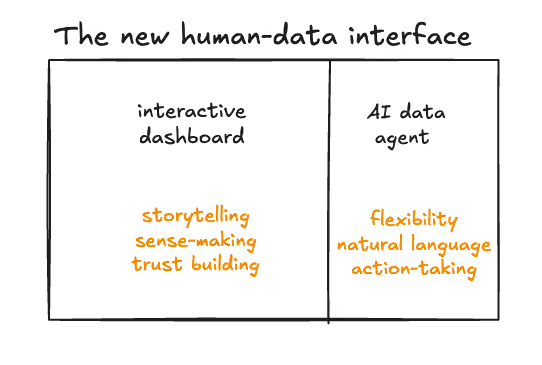
Bundling these two elements into a single instance makes each more useful:
- The dashboard gives structure to the agent’s answers.
- The agent removes the need to pre-build every view into the dashboard.
Why not one or the other? I see many people declaring the dashboard is dead in favor of the Data Agent. But people will tire of the blank slate as the only interface to data. See many of the excellent arguments Paolo Ciuccarelli makes on this point.
From predefined views to flexible understanding
In legacy analytics, every new question requires a new dashboard. That doesn’t scale.
A combined experience addresses the dashboard proliferation problem. The data backing the Ridge can contain more fields than are visible in the dashboard, so the Data Agent can answer a broad range of related questions that may not even be present in the dashboard.
Why not just agents all the way down?
So many agents! But sometimes a human still needs to understand some data. At the end of agentic workflows, people need something visual and interactive to understand the result. AI can do the grunt work along the way but it can’t insert understanding into our brains.
The default human-data interface has been a dashboard for a long time. There’s so much more innovation to come.