

Architecture
Ridge’s architecture is built from the ground up for fast, AI-enabled analytics.

.avif)
Why analytics needs a new architecture
Embedded analytics has traditionally been part of a monolithic server-based business intelligence system. That has led to multiple problems: poor performance, learning curves more appropriate to analysts than business users, pricing models that do not fit broad sharing use cases, and a monolithic structure that hinders flexibility.
Ridge AI takes a new approach. We use browser-based technology and open source frameworks to deliver an extremely performant, interactive experience. We combine the best of traditional visual approaches and AI to make it easier for anyone to build, explore, and act on analytics. Ridge creates a standalone, in-browser analytical app that spins up and down whenever a user accesses the page.
The benefits of this approach include:

Local, in-browser computation means selections and filters compute in milliseconds rather than tens of seconds.

Analytics can be embedded where the user is working rather than requiring them to enter a separate BI environment.

Ridge scales by taking advantage of end-user hardware. No need to size a server for peak loads to ensure scalability.

Local computation means lower server compute costs. Thisis a real consideration when not just users but agents are issuing queries.
An in-browser analytical application
A Ridge is an integrated dashboard and data agent with a shared set of context and data. Ridge does not treat a dashboard and chat interface as two separate ways of querying the same warehouse. They are two interfaces into the same analytical application.
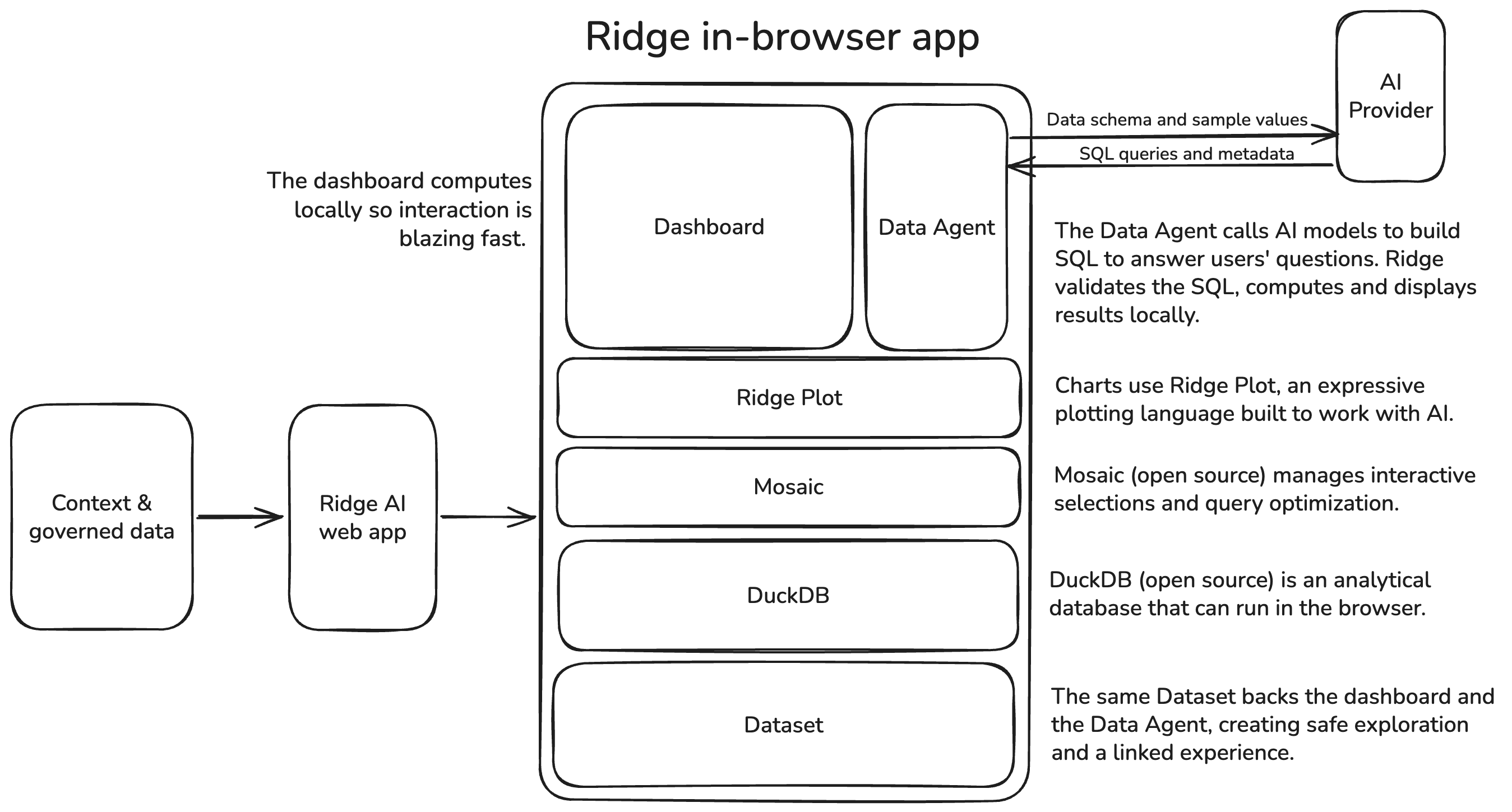
The in-browser app serves analytics to users.
It includes:
- The data required for the application (Dataset)
- The dashboard specification, for big-picture storytelling
- The AI harness for the Data Agent, for natural-language Q&A
- Foundational technologies: Ridge Plot, DuckDB-WASM, and Mosaic
The web app helps builders create & deploy.
What it does:
- Facilitates eliciting analytical context, as supplied by a user or agent
- Produces the dashboard specification via the Build Agent
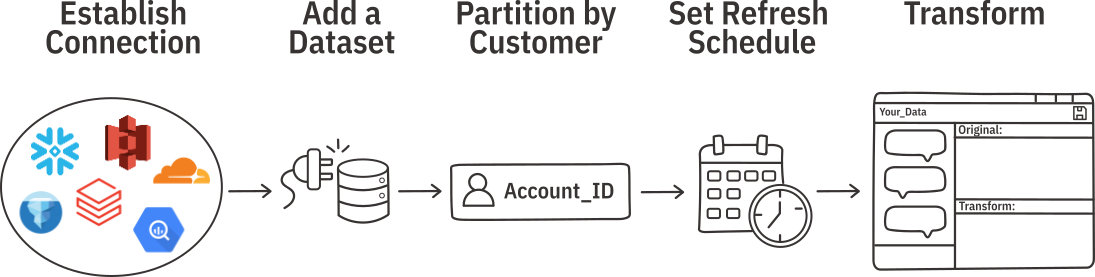
- Connects to, refreshes, and caches source data
- Partitions source data, if needed
- Supports transformations and data cleaning in the Transform Agent
- Serves the analytical app and appropriate data into the browser
How data works in Ridge
Ridge AI integrates with your existing data infrastructure. Rather than forcing users to define a complicated new data model or build a proprietary semantic layer, Ridge is designed to respect and work directly alongside any existing storage, transform, and governance layers.
This architecture allows organizations to simply connect to their data and get started, while Ridge handles the heavy lifting of managing authentication, maintaining the connection, and refreshing the data. Ultimately, this approach enables you to leverage your current data stack without the need to build or maintain redundant shadow data infrastructure.
Ridge supports data refresh and partitioning for Data Connections (enterprise data sources like Snowflake, Databricks, S3 and most databases).
Technical underpinnings of fast in-browser analytics
We build on these technical foundations to deliver AI-native, performant analytics.
DuckDB-WASM: High-performance database
DuckDB provides a high-performance analytical database engine. WebAssembly allows that engine to execute inside a modern web browser. This yields efficient columnar analytical processing close to the interface.
Mosaic: A framework for interactivity
In Ridge’s architecture, the Mosaic open-source framework coordinates the analytical applicatio, including query management, interactions like filtering and selections, caching and pre-aggregation.
Ridge Plot: A library for AI-native analytics
Ridge Plot is a full-featured interactive grammar of graphics that supports declarative specifications both at the charting layer and at a level of abstraction higher. This enables rich data and design validation and fewer AI errors.
Ridge is secure by design
Security is critical and part of our design process. Data in-browser is deleted by default once the user closes the browser tab. Caching across browser sessions is possible, if the builder allows it for both the Data Connection and the Dataset.
Partitioning allows customers to determine which data is set to which customer based on an immutable field per Dataset, such as an account id or customer id. Ridge uses JWT-based user and tenant scoping so that a user can always see only what they are authorized to see in a particular Dataset.
Ridge AI follows security best practices including secure credential storage and data encrypted in transit. Ridge is SOC 2 Type II compliant.

Ridge’s architecture is built from the ground up for the AI era.
Ridge changes where analytics run, how they are built, and how users interact with them. By moving computation into the browser and unifying dashboards, agents, and interactivity in one analytical application, it replaces the heavy, server-centric BI model with something faster, more composable, and more scalable.
That shift makes analytics easier to embed, cheaper to operate, and far more responsive to both people and agents. More importantly, it opens the door to analytics becoming a native part of every software workflow rather than a separate destination.