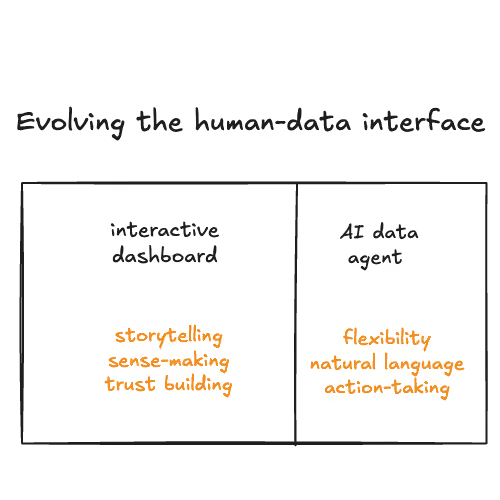
We're in the middle of an inevitable decline of monolithic business intelligence systems. Anthropic's announcement of Claude Dashboards is just part of it.
The system that is emerging will be better: one where more people, not just experts, can understand, share, and act on data.
The emergence of modern analytics systems
Why now?
A major factor is, of course, AI.
AI is doing more of the artifact creation.
Whether in a product like Claude Dashboards or an AI-native product like Ridge AI that harnesses foundation models, people are using natural language to interact with data. This means it’s much easier for non-experts to answer a question with analytics. It also means people are turning less and less to legacy tools, which often require expert-level skills.
Two other longstanding trends are contributing to the change:
The data stack matured over the last 1-2 decades.
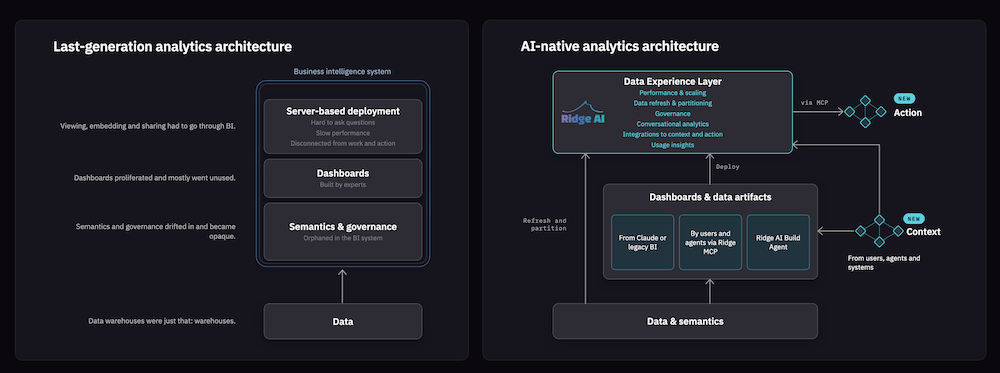
It now incorporates semantics and governance – essential for the transition to AI-based analytics. Customers had previously relied on BI systems for that, but in those systems, semantics and governance became opaque and often duplicated in multiple systems.
The long era of stagnation in analytics is over.
This left a generation of customers with aging deployments. Those organizations are now open to change. Many organizations are actively seeking change because:
- Performance of legacy systems was generally terrible.
- Dashboards were mostly not used.
- Analytics lived inside the BI system, disconnected from where the work was happening.
- Pricing was very, very high.
The combination of these factors mean that BI customers are paying a lot for systems that are doing less and less: they aren’t creating the analytics or managing the semantics. What they’re left with – deployment – they do badly, with slow performance and poorly designed, bolt-on AI experiences.
What comes next?
We believe there is an emerging layer that supports data deployment. This layer has several characteristics:
- The ability to draw on whatever data and semantics exist, rather than re-creating them.
- A richer, more integrated user experience that is performant and enabled with natural language.
- The ability to bring in context and take action with MCP.
This shift brings the potential of a better experience for business users. Legacy BI focused on artifact creation– published artifacts in were slow and disconnected from work. There was no opportunity to ask follow-on questions, so dashboards proliferated. A modern data experience layer can address each of those shortcomings.
Why a data experience layer?
The dashboard may be a commodity, but the user experience is not. Throwing more dashboards at people isn't going to make them use data more effectively. Especially because those end-users need to be able to use natural language just as much as the analytics creators did!
We need to treat the deployment and experience of data as a first-class object.
Claude Dashboards, like other LLM-built dashboards, are great ad hoc tools but don't provide a good shared experience. They're limited in the amount of data they can handle and must refresh data and deploy through another system. They don’t manage tenant isolation or permissions. They don’t provide interactive performance against hundreds of thousands or millions of data points. Anthropic is partnering with BI systems for all of that, but that's using those systems for the work they are worst at.
A more natural place for that user experience to live is in AI-native, composable analytical applications. Deployed at the edge for performance, connected to data and business context, and integrated into places where people already work.
The monolith is breaking down. Usable, composable analytics that are more integrated into work are coming.
That’s what we’re building at Ridge AI– the ability to deploy shared analytics easily, with a great experience for the people using them.
AI is breaking analytics out of legacy systems. It’s about time.